Showing posts with label WAC. Show all posts

Tuesday, September 8, 2015

A Day in the Life of a Center Child Care Licensor

At the beginning of July, DEL featured a blog post entitled “A Day in the Life of a Family Home Child Care Licensor.” The article featured an in-depth description of what a family home licensor encounters on an average day at work.

While family home child care is common throughout the state, there are licensors that specialize in monitoring and working with child care centers as well. The following post was written after spending an afternoon shadowing a DEL licensor while she visited a licensed child care center in Spokane. 
“Centers are another world,” said Helen Cramer, DEL Center Licensor in Spokane. “There are generally more children and more space to regulate, as well as different standards.”
Center classroom coat and book bag area.
The Department of Early Learning (DEL) is responsible for licensing and monitoring child care facilities around the state to ensure providers meet the health and safety requirements necessary for children to receive safe, healthy and quality care while parents are working or away.

DEL's licensing work is guided by 
state lawsstate rules, which are also called WACs (Washington Administrative Codes), and internal DEL policies and procedures

Not unlike family home licensors, center licensors spend a large amount of their time on the road and "in the field."
All DEL licensors (homes and centers) are currently equipped with tablets that can connect to the Internet when needed to ensure open and consistent dialogue with supervisors, licensees and colleagues. Tablets are also used so licensors have constant access to WAC documents and guidelines, as well as the electronic forms used for inspections. 
“One of the reasons for the tablet is that licensors are now able to provide forms, resources and licensing checklists to providers via email while on the premises,” said Licensing Supervisor, Karen Christensen. “We also use our tablets to bring up the MERIT system, background checks and other sites that are of use to the provider and can be viewed by the provider during the site visit.”
MERIT is a system used by early childhood education professionals and child care providers across the entire state. For more information about MERIT, go here: MERIT.
“The first thing I do is walk through the entire center,” said Cramer. “This allows me to get a general feel for the surroundings—see if anything stands out right off the bat.”
Center sizes vary greatly—this one in particular had around 120 children ranging in ages from infant to school-age. In a center, there is usually a larger staff dedicated to different age groups.

Classroom and play area at Spokane center.
At this center, the rooms were designated by color and age group (e.g. the Teal Room for preschoolers).


The licensor made notes and asked the center director questions about the general first impressions of the center. She paid special attention to each room’s functionality and safety—marking the placement of cleaning products, inquiring about medications for each child, and checking the cleanliness of each space.

Not unlike licensed homes, licensed centers are held to a set of standards and can receive violation notices that need to be addressed by the center administration.
“Child safety is our number one priority,” said Cramer. “We [center licensors] work with administrators to achieve the best possible standard of care for the kids.”
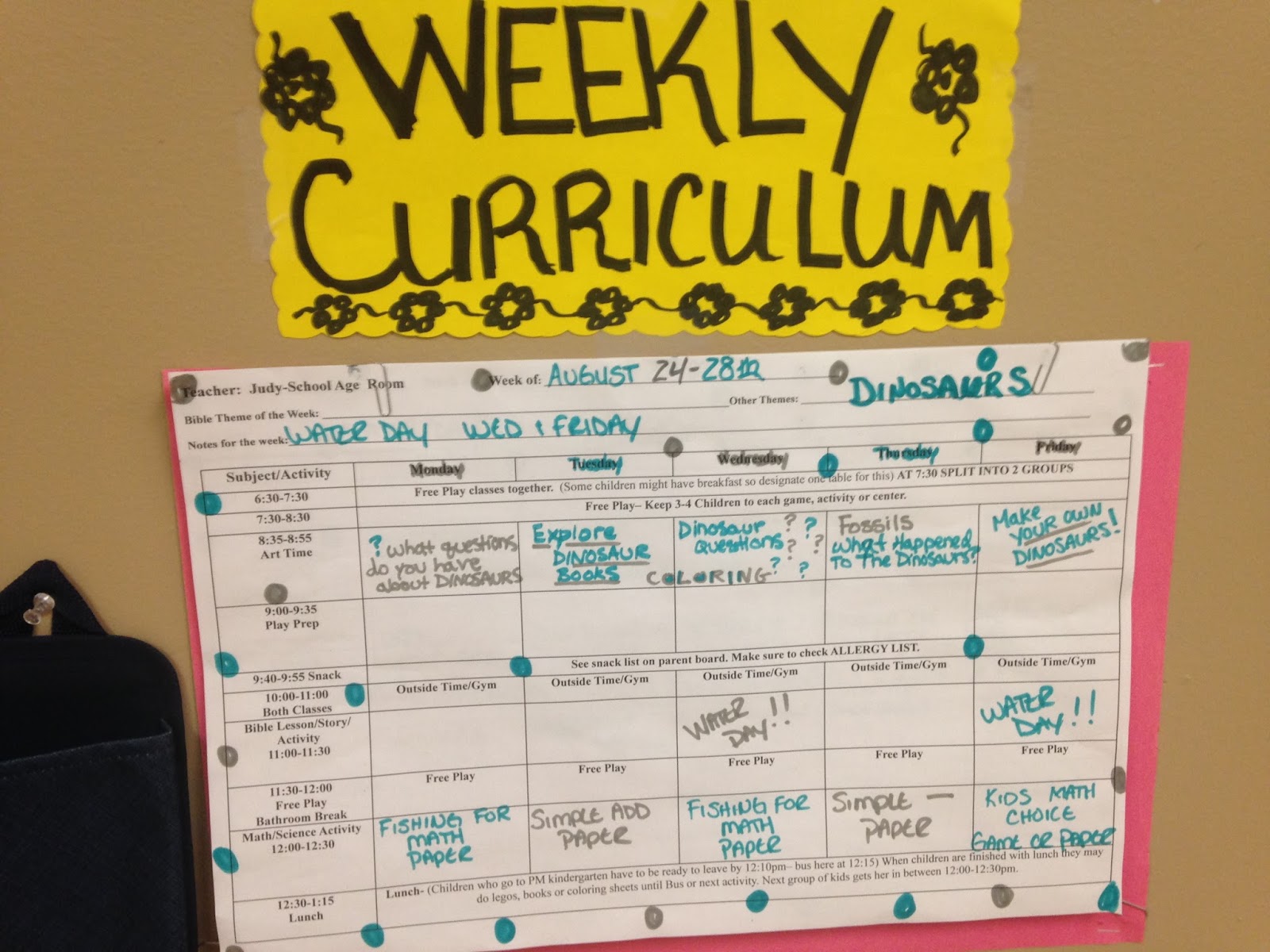
Sample of a Center curriculum posting.
During the bulk of the visit, Cramer surveyed the nap areas, play spaces (this center has its own gym!), and bathrooms. She notes status of fire alarms, placement of epi-pens for children with allergies, pays attention to the layout of the play areas (both indoor and outdoor), and reviews each staff member’s curriculum (which was posted in each room).

All licensors are required to conduct monitoring visits each year using an in-depth checklist of requirements. Center licensors may need to take more than one day to complete a monitoring visit—depending on the size of the center.

If a licensor finds that certain areas of the center checklist are not up to code (according to the WACs), the provider and the licensor develop a compliance agreement with a plan of correction stating that they will fix the issues in a certain amount of time. 

Violations are available for anyone to view online at DEL's Child Care Check. These violations range in severity. A violation could be failure of reporting or record keeping - failure to keep record of a child's vaccination history, or a violation could involve lack of supervision.  

Working with large centers is unique and it can be challenging to regulate. There are usually multiple staff files that licensors have to monitor. For example, staff members are required to have current CPR and First Aid training while caring for kids in a center, licensors must take note of this.

Licensors take the health and safety of children seriously--and are fast to act if they feel a provider is putting children at risk. Summary suspensions are served to centers that have allegations that pose imminent risk to children.
“One of the topics I try to bring up with each center I visit lately is Safe Sleep,” said Cramer. “We are rolling out new rules about this and we want to make sure centers are aware of the changes.”
This particular center had a well-established curriculum, caring, motivated staff members, and had the look and organizational feel of a school.
"Families who choose child care in a center setting usually choose programs because they see a close connection between a center and a school-like atmosphere," said Cramer. "There is also the opportunity for diverse interactions with multiple staff members and children of varying ages."
Her day usually ends after she has surveyed the center, spent a lot of time with administration, and reviewed files of all staff thoroughly.

Centers often have a lot of positive resources for children and offer different organized curricula for children of all ages. For example, it is common for centers to offer well-organized and well-chaperoned field trips--this may be an opportunity for children to bond and travel to new and interesting places in the care of qualified staff. 

If you are looking for child care, don't be afraid to ask questions of potential providers or to visit. All of DEL's WACs and policies and procedures are available online, and their subject matter ranges from safe outdoor play equipment to safe sleeping practices in child care settings. A good place to start learning about licensed child care in WA is here.  

Tuesday, February 21, 2012

Frequently asked questions about family home child care licensing rules available

The updated family home child care licensing rules take effect March 31, 2012. The Department of Early Learning (DEL) has been gathering questions from licensed providers and put them into a new "frequently asked questions" document that is on our website.

The family home rules are the result of an extensive, four-year negotiated rulemaking process between DEL, the SEIU 925 and others. The negotiated rulemaking team reviewed the existing family home rules, reviewed national research around child care safety and health, and made recommendations to DEL.

The rules do several things, including increasing education and training standards for providers and staff; enhancing standards around playground safety, food service, cribs, emergency preparedness, nurture and guidance, and screen time; and requiring a higher level of communication with parents around child development.

Learn more about the rules and watch the video of a December 2011 training webinar online.

Do you have questions about the updated rules? Email them to rules@del.wa.gov.

Tuesday, January 24, 2012

DEL accepting public comment on several rules

It’s a new year, which means it is time for new rules related to many areas that affect DEL, parents, child care providers and even unlicensed providers. The rules that govern how state agencies do business are called WACs (pronounced “wax”), which stands for Washington Administrative Code.


Part of the rule-making process is accepting public comments on the proposed changes. Right now, DEL is accepting public comment on several rules. People can provide comment online, in person (in some cases), by email or by postal mail. Each topic has a link to the webpage that contains more information, including how to provide input.

This list is organized by the date in which the public comment period closes.

January 31

  • Child Care Center Rules on Lice and Nits: DEL agreed to review the rule following a public petition asking DEL to remove the section of the rule that requires licensed child care centers to exclude children or staff who have lice or nits. This rule only applies to child care centers and school-age programs.
February 13
  • Public disclosure of DEL records, how the public may request records, indexes to certain public information and DEL organization rules required by law. 
  • Child care centers and school-age centers on new nonexpiring licenses: A nonexpiring license is available to current providers with a full license, and to new providers who have successfully completed the initial license period. The proposed rules describe the annual requirements for a provider to maintain a nonexpiring license.
  • Raising annual license fees for child care centers and school-age centers: DEL raised fees for family home child care providers in new WAC chapter 170-296A. The Legislature directed DEL to increase license fees for all licensed providers to deal with projected 2011-2013 state budget deficits. License fees are deposited to the state general fund and are not kept by DEL. The new fee amounts have been in effect by emergency rules filed in June and October 2011.
  • Suspected unlicensed child care and higher civil penalties (fines) that may be levied for violating child care licensing rules: The rule changes are as a result of 2011 Senate Bill 5504, and have been in effect by emergency rules filed in July and December 2011.
  • Working Connections and Seasonal Child Care programs in Washington Administrative Code (WAC) 170-290, and related changes to licensing rules for child care centers, school-age programs and family home child care. The rules are being revised to meet state and federal audit recommendations, reduce potential fraud, waste or abuse, comply with portions of 2011 Senate Bill 5921, and clarify other requirements.
March 31

  • Child care center rules: This will be the first substantial update of child care center rules since 2003. DEL is interested in suggestions that are child-centered and evidence- or research-based.
You can find the complete list of rules DEL will tackle the first half of this year on our semi-annual rule-making agenda, which we update every January and July.

Anyone who is interested in receiving information about current rules, draft rules and notices of rule changes, can sign up:

Rules Coordinator
Washington State Department of Early Learning
P.O. Box 40970
Olympia, WA 98504-0970

Tuesday, November 15, 2011

New family home child care rules will improve safety, outcomes for children

On November 14, DEL filed revised rules for family home child care providers. The revisions focus on health, safety and positive outcomes for children.

What are rules for family home child care providers?
DEL is responsible for providing rules for all licensed child care providers to follow, which are found in Washington Administrative Code (WAC). Child care centers and family home child care providers are subject to different rules. The family home child care rules have not changed significantly since 2004; the changes we filed yesterday are the first major update to the rules since licensing oversight became DEL's responsibility. The new rules will take effect in March 2012.

What does this mean for parents and children?
  • Providers are required to communicate more information about the their child care philosophy and about each child's development.
  • Enhanced safety standards for playgrounds, food service, cribs, emergency preparedness, screen time, and nurture and guidance.
What does this mean for family home child care providers?
  • A streamlined background check process, through nonexpiring licenses and portable background checks.
  • All children ages 13 to 16 who live in the home are subject to noncriminal background checks, as are volunteers or assistants ages 14 to 16 who work in the family child care home.
  • Providers and their staff will be required to meet increased education and training standards. The new rules require, at a minimum, a high school education or equivalent. Current licensed providers have until March 31, 2017 to meet the minimum education requirement.
  • DEL licensors will work with providers in the coming months to make sure they understand the new rules.
How did DEL decide on the rule changes?
DEL formed a group called the negotiated rule-making team that was tasked with developing the rule changes. The team was made up DEL staff, family home child care providers, the family home providers union, and other early learning professionals. Starting in 2007, the team collaboarated with providers, legislators, parents and early learning professionals to develop research-based draft rules. DEL presented the draft rules at eight public meetings around the state on evenings and weekends in Spring 2011. As required by state law, DEL also shared the draft rules with Service Employees International Union 925, the union that represents family home child care providers.

Read the final rules.

Watch DEL Director Bette Hyde discuss new rules: goo.gl/7OayM

More information about the rules is available on our website: www.del.wa.gov/laws/development/negotiated.aspx