Tuesday, January 10, 2017

Meet Colton: Early Intervention Success

The following is a guest blog post authored by a Pierce County mom:

Colton was the kid everyone looked at in public. At 24 months, he still couldn't speak. Colton would yell, scream, hit, kick, and bite his message across. He hated the smell of strong foods – they made him gag or vomit. He hated anything on his hands and would scream until we wiped them, but he hated the wet wipes as well and would scream even more. Good luck getting anything off his face without a wrestling match! His face was off limits: no wiping, no touching, not even a kiss goodnight.

Colton was constantly on the move. Jumping here and there, crashing into things. We had him evaluated for Autism Spectrum Disorder, but that was ruled out. 

We knew he had a speech delay and a sensory processing disorder. I was an exhausted mom. I was a frustrated mom. It's hard to admit, but I was also a mom who was embarrassed by his behavior. 

One of the biggest blessings of Children's Therapy Center Early Intervention program was having someone explain why our son was acting like this and giving us the encouragement and knowledge to support him. 

Picture Exchange Communication example.
I was surprised when his first therapist was a special education teacher, considering he had been referred for speech. But Stephanie was exactly what Colton needed. He couldn't practice speech until we helped him regulate himself. She taught us how to parent him with love and logic. She taught him sign language (“more,” “all done,” “help,” and “please”) so that he could request his needs. She gave us PECS (Picture Exchange Communication System) so that meals, snacks, and activities were no longer a guessing game ending in fights and tears. She saw his body and knew a SPIO® would help him gain control. She was right! He was like a different kid with it on. Stephanie saw that music helped him learn and calm himself, and she utilized it. She led a play group where he flourished and was motivated by his peers. Within 6 months, Colton went from speaking four to 60 words. He began tolerating wiping. 
The first person my son ever blew a kiss to was Stephanie. I think that's a bold expression of the amazing staff that CTC employs. 
The amazing, Colton!
Colton’s speech therapist, Alyssa, had participated in his playgroup and I think this familiarity made a huge difference. Her enthusiasm really drew Colton in. Alyssa was great at taking Stephanie's observations and utilizing games and songs to get him to enunciate. She showed us how to break words apart, target sounds, and practice repetition in positive ways. 

Colton also received occupational therapy with Marge. Marge really took the time to understand Colton. She observed his reactions and the environmental input and explained all of this to me in a way I could understand. She helped us see how his lack of speech was causing his aggressive behavior. Marge helped us make daily struggles (teeth brushing, hair washing, eating, bedtime) into tolerable and fun routines. She also noticed his weak muscles (hypotonia) and how they negatively impacted the simplest tasks. She taught us how to help him gain strength utilizing household items and games.
I was extremely nervous knowing that Colton would be leaving Early Intervention. All of his therapists and teachers were unconditionally supportive. They worked with me to review notes, prep for the evaluations, and calm any fears I had. With their help, we were able to get Colton the support he needs for the future via developmental preschool. 

Colton doesn't need to yell, scream, hit, kick, or bite to get his messages across anymore. He can use one of the 120 words he now has in his vocabulary. Colton can play with clay or paint with his sisters and wipe his hands calmly. Colton is still on the move but he is not crashing into things. He has much better control over his body and his emotions. 

Every night now, I can tuck him in and give him a kiss – something that would never have been possible without Early Intervention and his teacher and therapists at CTC. 

For more information about Early Support for Infants and Toddlers in Washington State, go to www.del.wa.gov/ESIT

Thursday, December 15, 2016

Statement from DEL, Proposed Expansion of Early Learning

On Wednesday, Dec. 14, Gov. Inslee unveiled his proposed 2017–19 operating, transportation and capital budgets. The budget roll-out follows the governor’s announcement Tuesday of his plan to fully fund basic education — and more to support kids, families, and teachers.
“This year’s proposed budget supports a vision for Washington’s future,” said Ross Hunter, DEL Director. “The investment our Governor has made will ensure children have the supports they need to succeed in the classroom, while parents and caregivers have the resources necessary to support their families outside of school.”
The governor’s operating budget:
  • Fully funds basic education
  • Invests in high-quality teachers and closing the opportunity gap
  • Begins transformative restructuring of services for children and families
  • Provides a modest pay increase to support a stronger state workforce
In regard to investment in early childhood education, the governor’s proposed budget:
  • Enhances rates for child care and preschool programs and providers 
  • Increases slots for children to enroll in Early Childhood Education and Assistance Program (ECEAP - State-funded preschool)
  • Includes funding for ECEAP additional facilities
  • Provides more slots for home visiting services
  • Expands summer learning opportunities in our state-funded preschool program
“We are excited to expand the capacity of our completely integrated state-funded preschool program, ECEAP and to increase capacity for our state’s smallest learners after the minimum wage increases for providers,” said Hunter. “Washington’s most at-risk children and families need access to preventative services and high quality early learning in order for this investment to yield a better future for our state.”
The Department of Early Learning was allotted approximately $75.5 million over the next two years (2017-2019). More details about the proposed budget and what that means for early learning in Washington State will be released. For more information about DEL’s budget requests, go to www.del.wa.gov/budget.

For more details about Gov. Inslee's proposed 2017-19 budget, please go here: Gov's Budget.

Tuesday, November 22, 2016

Director's Message: Minimum Wage Increase

Dear early learning professional,

As you know, Initiative 1433 to increase Washington State’s minimum wage passed this year with pretty large margins. This initiative provides for an increase in the minimum wage to $11.00 on January 1, and incremental increases until the wage rises to $13.50 in 2020. The initiative also requires paid sick leave for many employees.

We recognize that this wage increase can be seen as a two-sided coin. Wages for some of our lowest-paid educational workers and for some of the families you serve will rise to get a lot closer to a liveable wage. However, child care providers as business owners will face a significant financial pressure to raise rates to cover the cost of these increases.

We are aware that this initiative will present fresh challenges for some providers, and we are trying to better understand these implications from both an individual and systems level. The Department of Early Learning is generating a cost model for the Legislature to help them understand the constraints that private pay and subsidy childcare providers face with this new financial reality. While we do not have any shareable details at this time, we intend to make this analysis available to the public in December.

I would not normally write to all providers until we had more details to share, but many of you have written or called with concerns about this and I want you to know we’re hearing you and taking the steps available to us to provide you with more information.

Please look out for more information in the coming weeks. In the meantime, here are some resources that may help explain the new law: 


Sincerely,


Ross Hunter
Director

Wednesday, November 16, 2016

Recognize Your Hero: Celebrate Washington Parents

The Department of Early Learning’s (DEL) Strengthening Families Washington division, with the help of Seattle’s Child will recognized 28 parents in February 2017 at the State’s annual Unsung Heroes event.

The initiative is meant to honor “Unsung Heroes” or parents or caregivers who demonstrate strength, courage and empathy in their communities.

This year’s honorees from all over the State will be invited to western Washington for the 2017 Unsung Heroes event where family, friends and nominators can share inspirational stories about what it means to be an Unsung Hero in their communities.

DEL Director Hunter and Assistant Director Williamson
congratulate an Unsung Hero and parent at last year's event.
Last year, DEL Director, Ross Hunter as well as DEL Assistant Director, Greg Williamson awarded 29 Unsung Heroes and their families with a plaque and inspirational children’s book, The Dot after sharing dinner and playing with children attendees at Olympia’s Mobile Hands On Children’s Museum.

Each Unsung Hero’s story will also be available online at www.seattleschild.com/Parenting/ and will be shared on DEL’s Facebook page.

More about Unsung Heroes

Unsung Heroes has celebrated parents and caregivers in Washington State since 2011. Nominees are selected based on their ability to utilize five “protective factors,” in their work and/or personal life such as:

·         Knowledge of parenting and child development
·         Social connections
·         Parental resiliency
·         Concrete support in times of need
·         Social and emotional competence of children

If you are interested in nominating someone for a 2017 Unsung Hero award, please fill out the Unsung Hero Award Form and send it to strengtheningfamilies@del.wa.gov or by mail to SFWA, 1110 Jefferson St. SE, Olympia Washington, 98501.

Tuesday, November 15, 2016

ACH Payments Accepted Now for Background Check Fees

New this fall, an electronic payment option is available to individuals and providers who are paying the Department of Early Learning’s background check application fee of $12.

For a Spanish or Somali version of this message, please go here: Background Checks - Soomaali or here: Background Checks - EspaƱol.

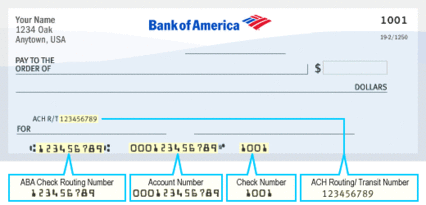
Automated Clearing House (ACH) is an electronic withdrawal directly from your checking or savings account. A bank account (checking or savings) and bank routing number are required for ACH electronic payments.

DEL will continue to accept check, money order or cashier’s checks through the mail. Purchase
orders are not an acceptable method of payment.

DEL will continue to work toward developing systems to allow for debit and credit card transactions in the near future, please look for further communication about this.

Frequently asked questions:
  • What is ACH? 
    • Automated Clearing House (ACH) is an electronic network for financial transactions in the United States. ACH processes large volumes of credit and debit transactions in batches. ACH credit transfers include direct deposit, payroll and vendor payments.
  • Why is it a secure way to pay? 
    • If you're concerned about security, ACH is a safe way to pay. You only need to expose your bank account information once – when you sign up for electronic payments – as opposed to every month if you write checks monthly. Unlike wire transfers, ACH payments are not immediate and irrevocable. 
  • When will DEL allow credit card payments? 
    • DEL fiscal and background check unit staff members are working on developing a system that will allow for secure and verified credit card payments. Please look for more communication regarding this in the future. 
  • Does DEL allow purchase orders? 
    • Not at this time. The approved ways to pay the background check fee are by check, money order, cashier’s check or via ACH. 
  • Where can I find my routing and account numbers? 
    • At the bottom of a check, you will see three groups of numbers. The first group is your routing number, the second is your account number and the third is your check number. See the image for reference. 
Do you have additional questions? Please refer all background check questions to the background check mailbox BackgroundCheck@del.wa.gov or 1.866.482.4325 #4.

Wednesday, November 9, 2016

State-funded PreK (ECEAP) Releases Eligibility Data

The Washington State Caseload Forecast Council (CFC) is required by RCW 43.88C to forecast the number of children who are eligible, as defined in RCW 43.215.405(5)(a), to participate in and the number of children actually served by the Early Childhood Education and Assistance Program (ECEAP) - Washington's State-funded preschool program.

By the 2020-21 school year, all eligible children shall be entitled to enroll in ECEAP, per RCW 43.215.456.
Because of this, the Legislature added 1,700 slots to ECEAP in the 2013-15 biennium and 1,600 in 2015-17. In the 2016-17 school year, ECEAP has 11,691 enrollment slots.
  • There are 23,445 children eligible for ECEAP who are not served by ECEAP or Head Start. Based on the November 2016 CFC forecast, 6,314 of these would likely participate if space were available. 
  • We are serving 50 percent of eligible children and 78 percent of children likely to participate.
  • By the 2020-21 school year, an estimated 7,429 more children would participate if space is available.
ECEAP is Washington’s state-funded prekindergarten program that prepares some of the State’s most vulnerable 3- and 4-year-old children for success in school and in life. 
To be eligible for ECEAP, children must be 3 or 4 years old by August 31 of the school year, not simultaneously enrolled in Head Start, and meet one of these requirements:
  • Qualified by their school district for special education services under RCW 28A.155.020.
  • Receiving Child Protective Services under RCW 26.44.020(3) or Family Assessment Response Services under RCW 26.44.260
  • From a family with income at or below 110 percent of the federal poverty guidelines established by the U.S. Department of Health and Human Services. In 2016, this is $26,730 for a family of four. This category includes all children in foster care and all families receiving Temporary Assistance for Needy Families (TANF) cash grants.
  • From a family that exceeds income requirements, but is impacted by specific risk factors that are linked by research to school performance (for example, child has a parent who is incarcerated or impacted by substance abuse). No more than 10 percent of ECEAP children can be in this “over-income” category, and most children enrolled under this provision are from families under 130 percent of federal poverty guidelines. 
Once eligibility is established, children are prioritized for enrollment in the available ECEAP slots using a weighted statewide priority point system.

To read the entire caseload forecast, go here: ECEAP Caseload Forecast.

Caseload Estimates

DEL recommends a gradual ramp-up, as displayed in the table below, to support a solid foundation for program quality.

Recommended ramp-up of new ECEAP slots


2016-17
2017-18
2018-19
2019-20
2020-21
Estimated new enrollment slots needed

1,857
1,858
1,857
1,858
Total ECEAP slots
11,691
13,548
15,405
17,262
19,120

Projections, assuming ECEAP ramp-up


2016-17
2017-18
2018-19
2019-20
2020-21
Total ECEAP-eligible
3- and 4-year olds
47,014
47,110
47,368
47,760
48,213
Served by ECEAP1
11,691
13,548
15,405
17,262
19,120
Served by Head Start2
11,325
11,325
11,325
11,325
11,325
Total ECEAP-eligible served by ECEAP or Head Start
23,016
24,873
26,730
28,587
30,445
Percent of ECEAP-eligible served by ECEAP or Head Start
49%
53%
56%
60%
63%
Percent of ECEAP-eligible, likely to participate3, served by ECEAP or Head Start
77%
83%
89%
95%
100%
Unserved, ECEAP-eligible
23,998
22,237
20,638
19,173
17,768
Unserved, ECEAP-eligible, likely to participate3
6,703
4,933
3,185
1,613
0

1 Based on proposed ECEAP slot ramp up.

2 The Head Start count is updated annually as part of the February forecast.

3 Likely to participate is based on the CFC assumption that 51% of eligible 3-year-olds and 77% of eligible 4-year-olds will participate.  

 Parents may choose other early learning services or choose to keep children home with them. 

Monday, November 7, 2016

Feedback Needed: Early Support for Infants and Toddlers

Prior to the 2016 Legislative session, oversight for the Early Support for Infants and Toddlers program was distributed across multiple agencies. This situation caused confusion and uncertainty for families and providers.

As a result, the Legislature passed a law (SB 5879) that required the following:

  • The Legislature established DEL as the agency of record and gave it full program oversight responsibility. DEL now has the authority to adopt rules related to Part C programs.
  • The Legislature voiced their frustrations with the accounting practices of the program and asked for a full accounting of ESIT expenditures at DEL and OSPI.
  • The Legislature asked DEL to propose a plan for program design and oversight that is due in December. 
Please find the most current version of the Department of Early Learning’s response to SB 5879 below. This document has been revised for clarity based on feedback provide at the October 19, 2016 State Interagency Coordinating Council (SICC) meeting and the October 21, 2016 webinar during which the same information was presented.
We have also included a link to the map of the proposed local lead agency (LLA) regions.

Additional elements of the plan that are yet to be incorporated into the document include:

  • proposed timelines,
  • updated cost study information and other fiscal components of the plan
  • logic model and
  • clarification of feedback from stakeholders (included in tables in the plan).

The next steps and timelines for our response to the legislation are listed below:

  • ESIT’s proposed rules were published in the State Register on Nov. 2 and are posted on DEL’s rulemaking web page. These rules are draft and indicate a direction but would benefit greatly from your input.
    • Creating an easily audited and transparent financial model for the ESIT program is essential to securing future investment and maximizing the amount of services we can deliver with the resources available. 
  • We will submit our draft plan to the Legislature in December. The Legislature will then respond to our plan. If they want changes, more information, etc., they will ask in the 2017 session which begins January 9, 2017.
  • There will be hearings on the proposed plan where testimony is welcome.
Legislative response on our plan and the budget decisions made in the 2017 session will have a profound impact on the direction of the program.

If you have any questions, please contact laurie.thomas@del.wa.gov.

The most current version of the Department of Early Learning’s response to SB 5879 is now available on the DEL website.

You can also find the recording of the stakeholder feedback webinar from 10/21/16 posted with the draft plan on the DEL website. This webinar was an opportunity for feedback, questions and answers.

We will be accepting feedback on the plan until November 10, 2016.  Please send any written feedback to Laurie Thomas at laurie.thomas@del.wa.gov