Showing posts with label child care. Show all posts

Friday, May 11, 2018

May 11, 2018 is Provider Appreciation Day!

Friday, May 11 is Provider Appreciation Day! Today, DEL recognizes the invaluable role that child care providers and early learning professionals play for our children.

Started in 1996 by a group of volunteers in New Jersey, Provider Appreciation Day is appropriately celebrated each year on the Friday before Mother’s Day. The founding organizers saw the need to recognize the tireless efforts of providers who care for children of working parents.

Parents are children’s first and most important teachers but regular caregivers, child care providers and early learning teachers are a close second. It takes a dedicated, energetic and giving person to guide, play, redirect, comfort and teach our littlest learners…not to mention, the immune system of a super hero!  

Thank you for your commitment, your love for the children in your care, and for the positive impact you have on our children.

Click here to learn more about Provider Appreciation Day. Share your stories of great child care providers with us on Facebook or on Twitter @DEL_wa! #ProviderAppreciationDay

Friday, May 12, 2017

Celebrating Child Care Providers in Washington!

Today is Provider Appreciation Day, a time for us to all celebrate the efforts of providers who care for and educate our state’s children. Here’s a message to providers from DEL Director Ross Hunter:

A Washington child care provider
comforting a sick child.
“Earlier this week I was asked to record a video for the Office of the Superintendent of Public Instruction reminiscing about a teacher who had been powerful in my life, as part of National Teacher Appreciation Week. It was really easy, fun, and made me smile to think about the impact my high school calculus teacher had on my understanding about how the world of mathematics actually works. Despite my fondness for Mr. Machemer, in the real world, pre-school and childcare teachers are where the impact on children’s developing brains is most powerful.

The opportunity you have as teachers of our littlest, most sponge-like kids is incredible, and you really can change the world for the better.

Thank you for your commitment, your love for the children in your care, and for the positive impact you have on our littlest learners.”

Click here to learn more about Provider Appreciation Day. Share your stories of great child care providers with us on Facebook or on Twitter @DEL_wa! #ProviderAppreciationDay

Tuesday, March 14, 2017

DEL Announces New Substitute Pool for Child Care

The Substitute Pool is designed to support family child care and child care center providers in accessing substitutes to work towards professional development goals to reach Early Achievers Level 3 or higher.

The Substitute Pool will:
Promote progress within Early Achievers by encouraging family child care and child care center providers to participate in professional development opportunities. This includes:
  • Substitute coverage to allow providers to participate in professional development opportunities.
  • Time to work towards achieving a Level 3 or higher. Allowable activities include:
    • Early Achievers Level 2 training series.
    • Completing self-assessments, action plans, or filing supporting documents.
    • Early Achievers Remedial Activities.
    • Early Achievers Technical Assistance and Coaching.
    • Environmental Rating Scale (ERS) preparation.
    • Classroom Assessment Scoring System (CLASS) preparation.
    • Education/Professional Development degrees or certificate programs.
Facilities that qualify to use the Substitute Pool:
  • Have served at least one child on subsidy within the last 12 months. 
  • Are enrolled in Early Achievers and working towards a Level 3 rating.
  • In good licensing status: this means having a non-expired license that is not suspended, revoked, or on probationary status.
Individuals that qualify to be a substitute in the Substitute Pool:
  • Are 18 years old or older.
  • Are registered in MERIT (visit www.MERIT.del.wa.gov to get started).
  • Meet the current minimum education standard for a licensed facility lead teacher.
  • Have evidence of the following in their MERIT record:
    • Initial Training Requirement (Child Care Basics)
    • DEL Portable Background Check clearance 
    • Child Abuse and Neglect training
    • Pediatric First Aid and CPR certification
    • Blood Borne Pathogens training
    • Tuberculosis test results
    • Safe Sleep training
    • Food Handlers permit
    • Mandated Reporter Training 
Once qualifications are verified in MERIT or there is a plan in place to complete them, substitutes must attend an in-person orientation with The Imagine Institute.

The Imagine Institute, a non-profit organization, will be administering the Substitute Pool. In addition to Substitute Pool administration, The Imagine Institute also offers trainings for both Family Child Care and Family, Friend, and Neighbor providers.

For more information about the Substitute Pool, or If you are interested in hiring a substitute or becoming a substitute, contact The Imagine Institute:

Phone: 206.492.5244
Email: subpool@imaginewa.org

Wednesday, February 22, 2017

Early Achievers Celebrates Parent Recognition Month

Early Achievers Pagers
New Early Achievers pages!
National Parent Recognition Month honors parents for the important roles they play in their homes and communities across the nation. Parent leaders may be a parent, grandparent, foster parent or any other care provider in a parenting role who share their perspective to effect change.

The Department of Early Learning (DEL) celebrates the contributions parents and families make to our society on a daily basis and recognizes that all parents have the potential to be great leaders. We are excited to announce a new online resource for parents and families to learn more about quality early learning in Washington through Early Achievers. Visit www.del.wa.gov/earlyachieversfamilies to learn more about:
    Family
  • The importance of quality child care and early learning
  • Early Achievers and how it is improving the quality of care in Washington
  • Finding quality early learning and care in your community
  • Additional resources and supports for families
The new pages also feature an expanded translated materials page for providers and all pages can be translated into multiple languages via the Google translate button at the top of each page.

For those who are interested in becoming leaders at the state level, the Early Achievers Review Subcommittee is currently accepting applications for members. This is a great opportunity to become involved in Early Achievers and its work to improve the quality of care for all children in Washington.

For more information, please visit: www.del.wa.gov/earlyachievers.

Early Achievers Logo

Thursday, February 16, 2017

Update on Licensing, Health, and Safety at DEL

(SoomaaliEspaƱol)

To the Early Learning Community,

The Department of Early Learning, which I have the honor to direct, regulates thousands of small businesses that provide childcare to 180,000 children in Washington every year. You hear a lot about “regulations crushing small businesses” and “regulations being critical to ensure safety.” Finding a balance between adequate safety and supporting childcare providers is important to getting the best outcomes for kids. 
  • We do fingerprint-based background checks on anyone who has unsupervised access to children, about 50,000 of these a year. This ensures that sex predators and people with a history of abusing or neglecting their own children don’t get to work in the industry. 
  • We make sure childcare facilities have fire safety checks, have safe playgrounds, have enough square footage to provide enough room for kids to move around, don’t have dangerous cords hanging down from window blinds, don’t have cleaning products or weapons accessible to children, etc. 
  • We make sure there are enough adults in the classroom to ensure safety. There are national standards for this kind of thing and we work hard to follow them. 
  • We ensure that facilities follow practices like safe sleep, food prep safety, good diapering practice to avoid fecal coliform infections, etc. 
  • We ensure minimum provider education levels because outcomes are much better for kids when they have a provider with a stronger educational background. 
  • We follow federally-required annual inspection schedules and incident follow-up deadlines.

Our goal is to prevent injuries and fatalities. Despite our best efforts some will occur, but many fewer than if we didn’t have rules providers have to follow.

In addition, we have a voluntary system (“Early Achievers”) that measures the quality of childcare. For taxpayer-subsidized kids we require at least a level 3 on our 5 point scale because it’s better for kids and we think taxpayers have a right to insist that they only pay for high-quality care. We pay more for higher quality care and instruction because it costs more. It’s worth it because we get better outcomes. Read more about Early Achievers here.

Like any regulator, we get complaints from the businesses that we regulate. They complain that our regulations cost too much to comply with, that our enforcement is biased against them because they are X, Y, or Z, or that we are inconsistent in our enforcement. Providers that have more than one location served by different licensors often have evidence that this is so, with different problems treated differently by different licensors. 

I try to approach problems like this analytically, so I asked for a systematic review of discipline practices across the state in my first few months. It turns out the businesses are right – we have different practices in different places, and often between different licensors inside the same office.  This isn’t OK, but it is a challenge to fix.  We have to have the regulation, but we also have to enforce it the right way. To improve the consistency and appropriateness of our licensing effort we’re doing the following: 
  1. Clarify the rules. Our rules should be readable by providers who have a high school education, our minimum educational requirement. We are in the middle of a complete re-write of what was a complex, multi-part document that had been written in pieces over decades. We’re aiming to be consistent across different types of facility – family child care homes, centers, and our state-run preschool program called ECEAP.
  2. Set clear expectations about consequences for violations. Safe sleep violations put vulnerable infants at risk of crib death. Keeping your paperwork in order so you don’t waste the licensor’s time checking everyone’s CPR training status is important, but perhaps not as much as safe sleep. We’re “weighting” the rules so our licensors and the small businesses we regulate can see how seriously violations of different rules will be treated.
  3. Training our staff. We’re planning to engage in a continuous review process on the new rules. Licensors will gather in groups to work through responses to common (and uncommon) situations that often get different responses and ensure that we’re all treating things the same way. We’ll document these cases to use as training for new licensors, and make them available to providers to see actual examples.

This isn’t an overnight project. The rules revision alone has already taken most of a year and we expect another 6-10 months of feedback, analysis and work to finalize the changes. It’s hard enough to change rules that we want to get it right. This is called the “Alignment” project, and you can read about it here.

We’re in the middle of the “weighting” process now, and are using a somewhat complicated but evidence-based approach to this to ensure that lots of stakeholders have input into the weights. Read about the weighting process here. 

Part of ensuring consistency of application of these rules is having an appeals process that makes sense. Our current process is just to have the supervisor of the original licensor review the decision. This doesn’t result in a lot of corrected actions and also doesn’t help build consistent practice. We’re moving to a new system where appeals go to a rotating group of experienced licensors who get to look at appeals monthly, without identifying information. This eliminates any implicit bias we may have about a provider and gets a single interpretation across the whole agency of the issue that’s come up. Our new process should roll out this spring. 

In addition to the formal steps we’re taking, we are investing in upgrading our software infrastructure so that licensors can track their observations on regular monitoring visits. Our new system is based on Salesforce.com and works in the cloud.  We expect it to be easier to manage as well as being a useful tool to see how peers react to concerns a particular licensor may have. 

Building a regulatory system that is too extreme can result in significant compliance costs for providers. There needs to be some rules (not having enough adults in the building is cheaper, but very, very dangerous) but having too many onerous rules can push providers out of the licensed world. Sometimes it’s hard for parents to tell the difference, but it matters. We shut down an unlicensed facility in 2016 when we discovered there were way too many infants for one provider to manage and a person living in the household who was a level one sex predator with a gun collection. You might not be able to see this from the outside, but you don’t want your kid there. 

Finding the right balance is tricky, and we depend on public input to make the determination. It’s like taxes. It always feels to a taxpayer that their taxes are too high, but the societal costs of having an inadequate education system that the taxes pay for are much more severe. The safety and outcome implications of getting the balance of childcare regulation wrong are pretty severe as well, and it’s worth being thoughtful about how we approach it. 

We’ll keep updating and engaging with you over the next year as the projects I mentioned above move forward.

Sincerely, 


Ross Hunter
Director, Washington State Department of Early Learning


Tuesday, January 24, 2017

A Day in the Life of an Early Learning Center Director

In 2015, DEL featured a set of blog posts that provided an in-depth description of what a family home child care licensor and a center child care licensor encounters on an average day at work.

Today, we will focus on an average day of work for the early learning professionals who run child care programs in centers and in family homes, providing high quality early learning to Washington children. The following post was written after spending a day shadowing Lois Martin, director of the Community Day Center for Children in Seattle’s Central Area. 

About Community Day


Founded by Lula Martin in 1963, Community Day Center for Children (CDCC) is in Seattle’s Central Area neighborhood. They serve 37 children, 13 percent of whom receive Working Connections Child Care subsidy. The CDCC lives up to its philosophy to provide a culturally diverse atmosphere where children learn through social interaction. The staff is comprised of African American and East African educators and the children come from a variety of racial, cultural, ethnic, and economic backgrounds.

Lois Martin wears many hats throughout the day. From her office she has eyes and ears on the activity in each classroom. She communicates regularly with staff over walkie-talkies.  She announces updates to classroom coverage when two teachers are out for the day, advises teachers about shortened outdoor play time schedules because of cold weather, and reminds teachers to look out for flu symptoms after two children go home ill.

Quality Matters


CDCC is participating in Early Achievers, but has not yet been rated. This is evident in her constant attention to child/ teacher ratios and the ability of staff to meet the individual needs of each child even on short-staffed days. Martin shared that she and her teachers were using Early Achievers tools several years before enrolling in the quality improvement program because of the center’s affiliation with the City of Seattle Comprehensive Child Care Program. 
When asked about how Early Achievers influences her day-to-day work, Martin notes that her first priority is the health and safety of the children and her staff. 
Martin shared the importance of utilizing these types of tools to analyze how the center classrooms encourage quality early learning experiences for the children. For example, they recently went through each classroom, as a group, to talk through several environment rating scale checklists and how teachers are using the different materials.

Supporting her teaching staff in their ongoing professional development is another important part of Martin’s role as director. Most of the CDCC educators are in school with three pursuing a Child Development Associate (CDA) certificate, two pursuing Associate of Arts (AA) degrees and one pursuing a Bachelor of Arts (BA) degree. Martin helps her staff find conferences and training to aid in their professional development and provides them opportunities to apply their learning as leaders at the center. She wishes there was more time to dedicate to training as a group.

Lois Martin, director of CDCC,
 comforts a sick child sleeping in her lap. 

Community Minded


Martin is also actively involved in the community surrounding the center. Today, in addition to her errands and coordinating adaptive schedule changes in classrooms, she has a phone conversation with a community member about plans for the dedication of new outdoor space on the Garfield Campus and their hope that it will become a community living room that serves as a safe space for all. She recalls the ways the neighborhood has changed over the 24 years she has been directing the center. While most of the children live within an 8-block radius of the center, many center teachers are no longer able to afford to live in the neighborhood. 

The ability to retain and continue to provide high quality care to families who receive Working Connections Child Care (WCCC) subsidies was the major impetus in the center becoming a part of the Early Achievers program.  It is important to Martin that CDCC maintain a socio-economic mix of families at the center, so she is willing to take the extra steps to make this possible. For example, today she makes a call to the DSHS provider line to confirm the center received a past-due co-payment.  Then Martin calls the parent to assure her the balance is cleared up and a called was placed to the WCCC call center.  
“If you really enjoy it, it becomes a part of your life and everything you do… That is how you obtain quality, we must pay attention to it every day,” Martin said.
As the day comes to an end, parents stop in to chat with Martin. She shares highlights from the day and they laugh about communal stories. She pulls out the walkie-talkie and cheerily praises her staff for their good work taking care of each other and the children on a short-staffed day, and reminds them to stop by the office to pick up treats left by a family in appreciation for the center’s dedicated staff.

Know of a special place where Washington children grow and learn? Send ideas to communications@del.wa.gov

Tuesday, November 22, 2016

Director's Message: Minimum Wage Increase

Dear early learning professional,

As you know, Initiative 1433 to increase Washington State’s minimum wage passed this year with pretty large margins. This initiative provides for an increase in the minimum wage to $11.00 on January 1, and incremental increases until the wage rises to $13.50 in 2020. The initiative also requires paid sick leave for many employees.

We recognize that this wage increase can be seen as a two-sided coin. Wages for some of our lowest-paid educational workers and for some of the families you serve will rise to get a lot closer to a liveable wage. However, child care providers as business owners will face a significant financial pressure to raise rates to cover the cost of these increases.

We are aware that this initiative will present fresh challenges for some providers, and we are trying to better understand these implications from both an individual and systems level. The Department of Early Learning is generating a cost model for the Legislature to help them understand the constraints that private pay and subsidy childcare providers face with this new financial reality. While we do not have any shareable details at this time, we intend to make this analysis available to the public in December.

I would not normally write to all providers until we had more details to share, but many of you have written or called with concerns about this and I want you to know we’re hearing you and taking the steps available to us to provide you with more information.

Please look out for more information in the coming weeks. In the meantime, here are some resources that may help explain the new law: 


Sincerely,


Ross Hunter
Director

Tuesday, November 15, 2016

ACH Payments Accepted Now for Background Check Fees

New this fall, an electronic payment option is available to individuals and providers who are paying the Department of Early Learning’s background check application fee of $12.

For a Spanish or Somali version of this message, please go here: Background Checks - Soomaali or here: Background Checks - EspaƱol.

Automated Clearing House (ACH) is an electronic withdrawal directly from your checking or savings account. A bank account (checking or savings) and bank routing number are required for ACH electronic payments.

DEL will continue to accept check, money order or cashier’s checks through the mail. Purchase
orders are not an acceptable method of payment.

DEL will continue to work toward developing systems to allow for debit and credit card transactions in the near future, please look for further communication about this.

Frequently asked questions:
  • What is ACH? 
    • Automated Clearing House (ACH) is an electronic network for financial transactions in the United States. ACH processes large volumes of credit and debit transactions in batches. ACH credit transfers include direct deposit, payroll and vendor payments.
  • Why is it a secure way to pay? 
    • If you're concerned about security, ACH is a safe way to pay. You only need to expose your bank account information once – when you sign up for electronic payments – as opposed to every month if you write checks monthly. Unlike wire transfers, ACH payments are not immediate and irrevocable. 
  • When will DEL allow credit card payments? 
    • DEL fiscal and background check unit staff members are working on developing a system that will allow for secure and verified credit card payments. Please look for more communication regarding this in the future. 
  • Does DEL allow purchase orders? 
    • Not at this time. The approved ways to pay the background check fee are by check, money order, cashier’s check or via ACH. 
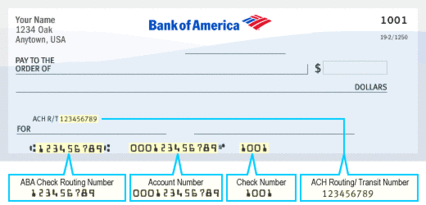
  • Where can I find my routing and account numbers? 
    • At the bottom of a check, you will see three groups of numbers. The first group is your routing number, the second is your account number and the third is your check number. See the image for reference. 
Do you have additional questions? Please refer all background check questions to the background check mailbox BackgroundCheck@del.wa.gov or 1.866.482.4325 #4.

Monday, October 24, 2016

Early Learning Health Update: October 2016

Healthy Active Living Learning Collaborative

Call for Applications!

One in four U.S. children under age five is either overweight or obese. These children experience greater school absenteeism, miss learning opportunities, and have increased medical costs. Early education centers have a chance to support national obesity prevention efforts through interventions and supportive policies that promote nutrition and physical activity. The National Center on Early Childhood Health and Wellness (NCECHW) is now accepting applications from programs to
participate in a Learning Collaborative process. This professional development initiative will give 10 teams the chance to implement healthy active living interventions in their program.

About the Learning Collaborative

Participants will engage in two in-person trainings to build fundamental knowledge and skills. Activities will promote team building and peer-to-peer learning for healthy active living initiatives around several areas. These include staff wellness, nutrition education, physical activity, and family engagement.

In addition, quarterly virtual training and technical assistance will be offered between learning sessions. Teams will use an action planning process to improve program quality. The teams will participate in a final in-person session in order to document successes, best practices, barriers, and implementation strategies.

Who Should Apply?
  • Head Start programs,
  • Early Head Start programs,
  • child care centers,
  • family home child care programs, and
  • preschool programs are eligible to apply.
This training is open to programs with previous experience in implementing policies and practices related to healthy active living, as well as those programs seeking to begin this work in this area.

The Application Process

Selected programs will receive $3,000 each to assist with the costs of facilitating activities that focus on programmatic and policy interventions. For more details about the award, please:

Important Dates and Deadlines

Applications are due no later than 4 p.m. EDT on Wednesday, Nov. 9, 2016. This includes the Online Application and completed Budget Template. Applicants will be notified of an award decision the week of Nov. 21, 2016. For all other dates, review the full Call for Application Guidelines.

Immunization Reporting: Centers, ECEAP and Head Start

Family home child care programs are not required to report at this time.

Thank you to all of you for reviewing your children’s immunization forms and for those who have already reported! Please remember to submit the required report by November 1, per state law (WAC 246-105-060). Here are a few important immunization updates and resources for early learning programs.

Email all questions related to reporting to: oicpschools@doh.wa.gov.


Annual Immunization Reporting
·        All child care centers, ECEAP and Head Start programs must fill out a reporting form and email or mail it to us rather than filling out a report online. The reporting form can be accessed here. Family home child care programs are not required to report at this time.

·        Look at our web page to find general information about child care reporting.

Immunization Requirements Resources
Parents can request a copy of their child’s Certificate of Immunization Status from our Immunization Information System (IIS). Click here for more information.

·        A new Certificate of Immunization Status will be available in the IIS in the near future. Click here to watch a recorded webinar to learn more about the new CIS.

Thank you very much for all your efforts to promote healthy children!

Department of Health Office of Immunization and Child Profile
PO Box 47843
Olympia, WA 98504-7843
Phone: 360-236-3595
Email: oicpschools@doh.wa.gov


“The Department of Health works to protect and improve the health of people in Washington State.”  

Tuesday, October 18, 2016

Provider Highlight: ABC Kidcare (Mount Vernon)

ABC Kidcare is a licensed child care provider in Washington State's Northwestern region, in Mount Vernon. This provider has used social emotional learning, healthy activity and parent engagement to prepare kids for Kindergarten!
Kids in licensed child care practicing healthy activity.

Learn more about this provider's successes in this short video courtesy of ABC Kidcare: Provider Highlight.

Please find the script for this video below or downloadable here: SCRIPT.
  • ABC Kidcare offers a unique small group setting where children generally begin their journey with us as infants and continue in the program through graduation into Kindergarten.
  • The transition fosters compassion, life skills, diversity and community-centered love for others and themselves. 
  • Children help each other thrive through responsibility and independence as they move from infancy to self-sufficiency, into preschool years. 
  • We strive to teach acceptance, compassion and love through exposure of diverse cultures, needs and community outreach programs. 
  • Our parent volunteer program encourages parents to come into the child care to teach about their careers, interest and heritage. 
  • Parents are always welcomed and our small group setting, with flexible agenda allows us to accommodate parent’s schedules and availability. 
  • On this day, one mom came to offer a glimpse into her marine biology career with a lesson on ocean life. 
  • To encourage an active lifestyle, this mom shares her interest, turned career, with weekly yoga lessons. 
  • To help promote our inclusive family approach through self-awareness, one of the first welcoming scenes in ABC Kidcare is the child cubbies with their family photos. 
  • This is continued throughout the children’s day beginning in infancy with our family photo albums. 
  • Our strong parent support network is built on group outings, parent support groups and cooperative babysitting exchanges—allowing parents to be connected with each other. This not only fosters an important teacher/parent relationship, but it is a community approach to parent-to-parent support. 
  • There is a huge benefit for the children to see the adults in their lives working together. 
  • The strong sense of community continues long after the children’s time at ABC Kidcare. With a smooth transition into Kindergarten, many families will continue to come to group events and stay connected to one another.
Know of a child care provider in your community that is willing to share positive experiences within their curriculum? Reach out to communications@del.wa.gov.

The views and opinions expressed herein are those of the author and do not necessarily reflect the views of the Washington State Department of Early Learning and its affiliates, or its employees.

Monday, August 29, 2016

DEL Posts Approved CCDF (Federal Funding Source) Plan


The Child Care and Development Fund (CCDF) is a Federal funding source that supports low-income working families by providing access to affordable, high-quality early care and after-school programs. CCDF also improves the quality of care to support children’s healthy development and learning by supporting child care licensing, quality improvement systems to help programs meet higher standards, and support for child care workers to attain more training and education.

In Washington, CCDF dollars fund essential programs in early learning, including but not limited to: 

  • child care licensing
  • quality rating and improvement system (QRIS) - Early Achievers
  • data collection and analysis to better understand child outcomes. 
The Child Care and Development Block Grant (CCDBG) Act of 2014 reauthorizes the Federal early learning law of 1996 and represents an historic re-envisioning of the Child Care and Development Fund (CCDF) program.

Learn more about the law.

As the lead state agency for the CCDF block grant, DEL must submit a plan every three years for how the funding will be used to improve accessibility to and quality of child care in our State. This past fall, DEL submitted the following:
See the 2016-2018 Approved CCDF plan here: Approved CCDF Plan.

If you have questions, please contact: Child Care Administrator, Lynne Shanafelt at Lynne.Shanafelt@del.wa.gov.

DEL Posts Approved CCDF (Federal Funding Source) Plan


The Child Care and Development Fund (CCDF) is a Federal funding source that supports low-income working families by providing access to affordable, high-quality early care and after-school programs. CCDF also improves the quality of care to support children’s healthy development and learning by supporting child care licensing, quality improvements systems to help programs meet higher standards, and support for child care workers to attain more training and education.

Authorization with CCDF has allowed essential programs in early learning to thrive including but not limited to: 

  • licensed child care
  • quality rating and improvement system (QRIS) - Early Achievers
  • homeless child care
The Child Care and Development Block Grant (CCDBG) Act of 2014 reauthorizes the child care program for the first time since 1996 and represents an historic re-envisioning of the Child Care and Development Fund (CCDF) program.

Learn more about the law.

As the lead state agency for the CCDF block grant, DEL must submit a plan every three years for how the funding will be used to improve accessibility and quality of child care in our state. This past fall, DEL submitted the following:
See the 2016-2018 Approved CCDF plan here: Approved CCDF Plan.

If you have questions, please contact: Child Care Administrator, Lynne Shanafelt at Lynne.Shanafelt@del.wa.gov.

Monday, August 22, 2016

DEL Restructures Licensing Regions

This should not mean any noticeable change for licensed child care providers. 
The licensing division within the Department of Early Learning (DEL) is currently going through a reorganization of its licensing regions, in order to spread workloads more evenly. Licensing administration has decided to use a number system, as well as a description of the location of the region.  
Below is a list of the new regional names and the offices that will fall within the new regions. Please also see the map of the updated licensing regions.      
Region 1 Eastern (light blue): Yakima, Wenatchee, Tri-Cities and Spokane   
Region 2 Northwest (green): Everett, Bellingham, and Bellevue 
Region 3 Southwest (orange): Tacoma 1, 2, Olympia, and Vancouver  
Region 4 South King County (purple): Renton 1, 2, and 3   
This should not mean any noticeable change for licensed child care providers.

If you have specific questions about this change, please contact your local licensing office: Contact Us

Monday, August 8, 2016

Licensed Child Care Providers: Lead Exposure Survey

Attention Child Care Providers:
Para espaƱol, vƩase mƔs adelante

Recent detection of lead in drinking water systems has raised public awareness of the effect that lead can have on young children’s development. Governor Inslee has directed State agencies to assess lead exposure risks to the public and to develop a plan for addressing any identified concerns.

As an initial step, the Department of Early Learning (DEL) would like to get an idea of how many early learning programs may be at risk for lead exposure. 

Common sources of lead exposure include: 
  • paint used on buildings built prior to 1978; 
  • lead piping in water systems built prior to 1986 and 
  • pesticides used on orchards prior to 1950. 
Currently DEL does not collect data on the age of family child care homes or center buildings.

 A “yes” answer to any of the questions below does not necessarily mean that lead is present in your facility. The survey closes on August 11. 

Survey: 

Luego de la reciente detección de plomo en los sistemas de agua potable, la población demostró su preocupación por las consecuencias que el plomo puede tener en el desarrollo de los niƱos. 

El gobernador Inslee ordenó a las agencias estatales que evalĆŗen los peligros que la exposición al plomo podrĆ­a presentar para la población y que desarrollen un plan para abordar cualquier problema detectado. 

En primer lugar, al Department of Early Learning (DEL, Departamento de Aprendizaje Temprano) le gustarĆ­a saber cuĆ”ntos programas de aprendizaje temprano podrĆ­an estar en peligro de exposición al plomo. Las fuentes de exposición al plomo mĆ”s comunes incluyen: 

  • la pintura utilizada en edificios construidos antes de 1978, 
  • tuberĆ­as de plomo utilizadas en los sistemas de agua construidos antes de 1986 y 
  • los pesticidas utilizados en huertas antes de 1950. 
Actualmente, el DEL no recopila datos sobre la antigüedad de los edificios de los hogares o centros de cuidados para niƱos. Responder “SĆ­” a cualquiera de las preguntas que se mencionan a continuación no implica necesariamente la presencia de plomo en sus instalaciones. La encuesta se cierre el 11 de agosto. 

Encuesta: 

Tuesday, May 17, 2016

State Welcomes New Statewide Licensing Administrator

The Washington State Department of Early Learning (DEL) is pleased to announce that Travis Hansen has accepted the Early Learning Statewide Licensing Administrator position. Hansen is currently the Regional Administrator for DEL’s North Central region, which includes counties from Okanogan in the north to southern Klickitat.

Travis comes to this position with a wealth of experience and dedication to early learning. He has devoted his passion and energy to Washington State social and early learning services for over 10 years. Travis’s professional history and his vision for licensing services as a foundation to a quality early learning system will be a great asset to the DEL administration team. 

Travis Hansen, Statewide Licensing Administrator
“I believe quality child care starts with a healthy and safe child,” said Hansen. “It is a true honor to be able to work in such a great early learning system in Washington State.”
For the last four years Travis has successfully lead licensing services in 13 counties of the North Central region, supporting children, families, early learning providers, and communities from the Canada to Oregon borders.

Prior to that, Hansen was DEL’s Licensing Supervisor for the Yakima Office, Travis also worked as a program manager, therapist, and a supervisor for various agencies, including the Department of Social and Health Services, Crest Counseling Services and EPIC Youth Services. 
“Travis brings many skills and talents that are transferrable and highly desirable to this new role,” said Luba Bezborodnikova, DEL Assistant Director.
More about Travis: 
Travis earned his Master’s degree in Social Work with a specialization in Counseling as well as Public Administration from Eastern Washington University. Hansen and his wife have five children of their own, Riley, Cooper, Chase, Brady, and Hunter—all boys.

Favorite children's book: Where the Wild Things Are by Maurice Sendak
Best childhood memory: spending the summers at Priest Lake in Idaho. 
"I remember running around all over the lake as a kid. We would camping, fishing, hiking, swimming, and have campfires every night."

Tuesday, March 8, 2016

DEL Celebrates Healthy Breakfast, Healthy Starts


Busy weekday mornings can make it a challenge for families to find time for a healthy breakfast. However, US Department of Agriculture data show that more students are starting their day with a nutritious breakfast in their school cafeterias. 

Even earlier, in child care, Head Start or ECEAP, Preschool-age kids are learning at an amazing rate every day. Preschoolers are just beginning to learn important concepts that lay the foundation for years to come. Eating breakfast improves concentration and mental performance. 
The American Dietetic Association states "that children who eat a healthy, well-balanced breakfast are more likely to meet daily nutrient requirements, concentrate better, have better problem-solving skills, have better hand-eye coordination, be more alert, be more creative, miss fewer days of school and be more physically active."
National School Breakfast Week was launched in 1989 to raise awareness of the availability of the School Breakfast Program to all children and to promote the links between eating a good breakfast, academic achievement and healthy lifestyles. 

A lot of the focus on this initiative is about school-age children, cafeterias and nutrition, but the message rings true for even the littlest learners!

The focus on healthy nutrition for children is a large part of the Healthiest Next Generation initiative, launched in September 2014. The initial goal was to help Washington’s children maintain a healthy weight, enjoy active lives and eat well by creating healthy early learning settings, schools and communities. 

Join the Celebration!

This week only, share a photo of your child or children's healthy breakfast or the breakfast menu at their child care, pre-K, ECEAP or Head Start on DEL's Facebook page or send it to us in a Facebook message, via email (communications@del.wa.gov) or Tweet it at us! We will spread the love on our social media accounts!


Monday, February 1, 2016

Outstanding Child Care Center Experiences Emergency

On January 20, 2016, a fire started during child care hours at KidSpace, Inc., a licensed center located in Vancouver, WA. All the children and employees evacuated in a quick and organized manner as noted in an article in the Vancouver Columbian. To read the article click HERE.

Having a disaster plan and performing regular evacuation drills are one of the requirements of being licensed to operate a child care facility in Washington state; for centers, this requirement is spelled out in WAC 170-295-5030. But beyond just meeting the basic requirements—understanding the importance behind why something is required, helps to motivate us to go beyond the minimum standards and aim for excellence.

No one wants to think about a fire or other emergency situation happening at a child care facility—but it happened at KidSpace and it can happen anywhere. Fortunately, this facility had a well-thought-out evacuation plan and practiced drills with enough frequency that children and employees did not need to think, but just react. 

A DEL employee in the Vancouver licensing office has a school-age child that attends this child care facility. In talking about the fire at the child care facility, the child initially thought that the evacuation was simply a drill because the teachers remained calm. It was only after the child got outside and saw fire fighters, did the child realize it wasn’t a fire drill but an actual fire!
Vancouver Columbian report shows firefighters
on roof of Kidspace.
 A licensed child care facility located nearby saw flames at KidSpace and offered this space to help out. 

This helped KidSpace employees keep the children out of the elements and block the potentially traumatizing view of the fire burning their child care center. Parents, emergency personnel and employees from the nearby facility commented on how the KidSpace employees remained calm and collected which let the kids know that they were safe.

After an emergency situation, it is a good time for all providers to evaluate emergency plans and make changes if needed. Mark Kastenbaum, SW Regional Health Specialist, has provided the following resources for emergency planning:
In light of the fire at KidSpace facility and the quick and organized evacuation—we want to use this opportunity to commend and celebrate the KidSpace employees’. The Vancouver licensing staff have been working very closely with KidSpace employees to evaluate temporary space for KidSpace to use while their permanent facility gets repaired and rebuilt.

After the dust settles a bit, we want to use this experience as an opportunity to study this scenario like a case study and work with KidSpace to evaluate their emergency evacuation plans and see if they would tweak anything if this were to happen in the future. By sharing this experience with other providers—we can promote sharing of best practices among the early learning community.

Wednesday, January 27, 2016

State Accepts Feedback on Federal Funding Plan: CCDF

More about CCDF

The Child Care and Development Block Grant (CCDBG) Act of 2014 reauthorizes the child care program for the first time since 1996 and represents a historic re-envisioning of the Child Care and Development Fund (CCDF) program.

The Child Care and Development Fund (CCDF) supports low-income working families by providing access to affordable, high-quality early care and afterschool programs. CCDF also improves the quality of care to support children’s healthy development and learning by supporting child care licensing, quality improvements systems to help programs meet higher standards, and support for child care workers to attain more training and education.

Learn more about the law.

As the lead state agency for the CCDF block grant, the Washington State Department of Early Learning (DEL) must submit a plan every three years for how the funding will be used to improve accessibility and quality of child care in our state.

Public Commentary Forum

For more information about the 2016 public commentary forum, click here: Public Commentary Forum Flyer. If you would like to participate in this event, please RSVP here: CCDF Public Forum.

To review the 2016 draft of the CCDF plan, click here: CCDF Plan Draft.

If you are interested in submitting commentary via teleconference, please contact communications@del.wa.gov as soon as possible. 

The deadline for public commentary is January 28 by 7:30 p.m.

Following the forum, public commentary will be posted online at www.del.wa.gov. The final plan will be submitted to federal review on March 1.

Thursday, December 17, 2015

Statewide Child Care Licensing Administrator Retires

The Department of Early Learning (DEL) announces today that Mary Kay Quinlan will retire from her position as the Statewide Licensing Administrator after nearly 40 years of licensed child care work in Washington.

Mary Kay Quinlan
Quinlan has made significant strides in improving the quality of licensing services and the availability of licensed early learning opportunities for Washington’s littlest learners. Under Quinlan’s leadership, DEL implemented a differential monitoring approach that supported consistency and efficiency of licensing practices. Her passion focused on safe and healthy environments for the diverse communities of children and families in Washington state.
“One of my proudest accomplishments is the data-informed improvement of licensing policies, procedures and regulations,” said Quinlan. “These improvements support providers and encourage them to develop professionally and to view the child care setting with health and safety of children as the main priority.”
Quinlan also enhanced DEL communication with parents and communities, creating an awareness of licensing regulations, policies and procedures, while promoting a “whole child” approach that acknowledges and honors the diverse needs of children during some of their most influential years.

Other key accomplishments under Quinlan’s leadership include:
  • revising regulations that enable home-based providers to focus on quality of their services and better care and education for early learners; 
  • engaging licensors and licensed providers in implementation of Early Achievers, our state’s quality rating and improvement system; and
  • initiating work on health and safety for infants and toddlers by implementing the Safe Sleep initiative and supporting the state Early Head Start and Child Care Partnerships collaboration.
“Under Mary Kay’s leadership, Washington’s child care licensing system has made tremendous strides in ensuring health and safety of early learning environments for our state’s youngest population,” said Heather Moss, DEL’s Deputy Director. “Our leadership team would like to congratulate her on an exceptional career in state service. Her commitment to ensuring the health, safety and educational opportunities for all children makes her a lifelong ally for the families we serve.”
Quinlan’s last day will be December 31, 2015. Luba Bezborodnikova, DEL Assistant Director for the Early Start Act, will assume the lead role in statewide child care licensing moving forward. Regional Licensing Administrators from DEL’s four child care licensing regions will also aid in this transition.

For all licensing questions, comments and suggestions please contact Luba Bezborodnikova, DEL Assistant Director for the Early Start Act at luba.bezborodnikova@del.wa.gov or 360-725-4404.

DEL’s Regional Licensing Administrators are also available for licensing questions as they pertain to different parts of the state:

Cammey Rocco, Regional Licensing Administrator (Southwest)
253-983-6413

Heather West, Regional Licensing Administrator (Northwest - King)
425-917-7967

Robert Kerwin, Regional Licensing Administrator (Eastern)
DEL Child Care Licensing Regions
509-789-3833

Travis Hansen, Regional Licensing Administrator (North Central)
509-834-6840